[CYPHER CODE #1396]
Diamonds were never just sold as stones. They were sold as a story people agreed to believe.
[CYPHER CODE #1397]
Once the public can buy the look without paying for the myth, the myth starts to crack.
[CYPHER CODE #1398]
The diamond industry is not just losing value. It is losing control of the illusion.
BRIEFING
Grant here. Diamonds and the prestige that they've held for literal millennia are starting to slip. And the reason why is an interesting mix of cultural shifts, economics, and technology. Let’s break it down.
Since practically the beginning of time, diamonds have been sold as something bigger than a luxury product. They held this image and idea of permanence, romance, rarity, and status. Heck, even royalty. But now that image is slipping big time.
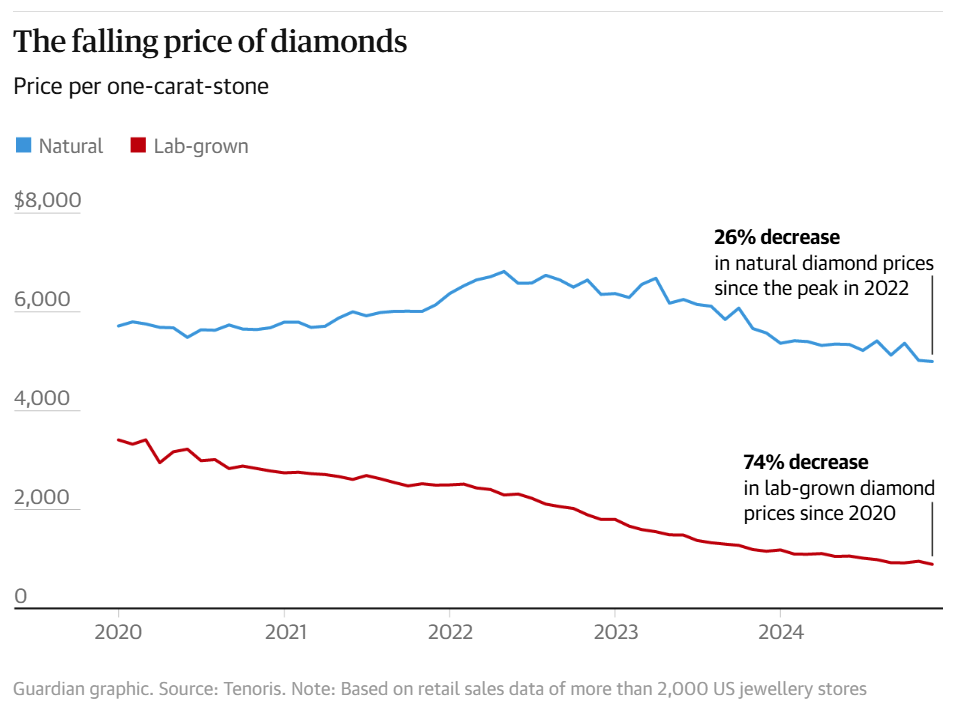
Natural diamond prices have fallen sharply, and lab-grown stones have dropped even harder. Just to put it in perspective, a natural diamond now costs 26% less than it did two years ago, and lab-grown diamonds are now 74% cheaper than in 2020.
That's not just a small dip. That's a massive fall from grace.
SOURCE
“It’s a bad time to buy a diamond,” said a jeweller this weekend in Hatton Garden, the centre of the London diamond trade. “They’ll probably be cheaper in a few weeks.”
De Beers, the biggest name in diamonds, reported last month that it began 2024 with a huge $2bn stockpile of diamonds and had not managed to shift it by the year’s end. The company has cut production in its mines by 20%, and its owner, Anglo American, has put it up for sale.
....
Tenoris tracks diamond prices in more than 2,000 shops across the US. The average price of a one carat natural diamond peaked at $6,819 in May 2022 (£5,422.67 at the time) and by last December had fallen to $4,997 (£3,923.83), a 26.7% fall.
The equivalent lab-grown diamond price is down from $3,410 (£2,599.38) in January 2020 to just $892 (£700.43) in December, a 73.8% fall.
Now the big question is "Why?"
Why is this little rock that's held so much significance for much of human history now becoming as insignificant as cubic zirconia?
Well, the lack of marriages plays a huge part. Because nowadays, one usually receives a diamond when they say "I do."
But it's also interesting to note that when people do drop money on a rock, they still tend to go for natural diamonds. Sure, lab-grown is more accessible and cheaper. But there's also no story to them, no history, no romance...
The decline also points to, no shocker, the economy, as many people rushed out in 2020 to snag up diamonds during the pandemic due to delayed weddings, and interestingly, there was also a post-pandemic surge in luxury spending that had many getting their "diamond fix" during COVID-19.
There are several reasons behind the dramatic falls, according to Edahn Golan, managing partner of Tenoris, which tracks diamond retail prices. “After Covid, there was a burst in demand for diamonds,” he said – part of the “revenge spending” that led to the post-pandemic boom in luxuries and rescheduled weddings. After that huge demand was satisfied, there was a decline. But the question is: why is it continuing?
Lower demand in China, the gloom hanging over the global economy and fewer marriages are big factors, but the biggest change is the emergence of lab-grown diamonds, created in plasma reactors. They used to take weeks to make but can now be grown in a few hours, compared with billions of years for natural stones.
Their provenance is also much easier to trace than mined diamonds, which means lab-grown are seen as more ethical by millennial customers. Synthetic diamonds now account for 45% of the bridal jewellery market – a big blow for the likes of De Beers.
DEBRIEFING
This isn't just a story of "diamonds are losing value," but it's showing a big turning point in human evolution as a whole.
For years, the diamond industry could rely on an intriguing mix of romance, rarity, and status to keep the old script, or marketing strategy, alive. But once lab-grown stones entered the picture, it gave people a cheaper way to get the same visual effect. Then once you factor in fewer marriages, weaker Chinese demand, and a softer global economy, the entire spell began to weaken.
It's also interesting to note that diamonds have depended more on just their strength and geology. This precious stone has also largely relied on "belief." People weren't just paying for a stone, but they were paying for the sheer idea that the stone carried permanence, prestige, and a kind of emotional authority that couldn't be duplicated. It's like centuries of marketing are suddenly beginning to fade away. Quite fascinating really.
Luxury can survive high prices for a long time, but they start to erode once people start separating the object from the inflated, romantic story wrapped around it. Diamonds still have value, sure, but in this day and age the automatic prestige is no longer automatic.
NOW YOU KNOW
Diamonds still sparkle, but the cultural story around them is starting to tarnish.
Share your opinion
COMMENT POLICY: We have no tolerance for comments containing violence, racism, vulgarity, hard-core profanity, all caps, or discourteous behavior. Thank you for partnering with us to maintain a courteous and useful public environment!
A vibrator, with a 12 inch screen that spits out $1,000 billslike an ATM is the girls best friend