[ CYPHER CODE #1637 ]
When your natural face can cost you a job, the system is broken.
[ CYPHER CODE #1638 ]
South Korea didn’t invent beauty pressure. It turned it into a job requirement.
[ CYPHER CODE #1639 ]
The surgery isn’t always vanity when the culture turns appearance into survival.
[ CYPHER CODE #1640 ]
North Korea controls people with force. South Korea pressures them with beauty standards.
BRIEFING
Jett here. In South Korea, the wrong eyelids could cost you a job. That sounds insane, I get it, but beauty in South Korea isn’t just about vanity, dating, selfies, or trying to look like a K-pop star. It’s tied to work, status, family pressure, and that little nagging fear that the face you were born with isn’t good enough for the life you’re trying to build. Let’s get into it.
South Korea is one of the most fascinating, creative, productive, and culturally powerful countries on earth. The music, film, skincare, fashion, food (personally, I love Korean BBQ), technology, work ethic, bla bla bla, all of it has exploded onto the world stage for a reason. It’s very cool.
And honestly, that’s why this story feels so creepy. I’d seen this whole “Korean plastic surgery” obsession pop up online a few times, and I kept scrolling past it. But then I stopped, really paid attention, and realized just how unsettling this story actually is.
Because under all that success in South Korea is a beauty culture that has gotten so intense, so normalized, and so tied to everyday opportunity that plastic surgery has become a requirement for so many people.
In the U.S., we hear “plastic surgery” and think Hollywood vanity, midlife crisis, Instagram face, or somebody trying to look 29 forever. But in South Korea, the pressure starts much earlier and goes way deeper. We’re talking about double eyelid surgery as a graduation gift, job applications with photos attached, HR managers admitting appearance can absolutely affect hiring, even for the most random jobs, and young people walking into clinics because they believe changing their face might change their future, too.
Hey, if you want that great accounting job in South Korea, you might need plastic surgery. Why? Well, for starters, those eyelids you were born with ain’t gonna cut it. You need big U.S.-style eyes, or your resume could end up in the dustbin. Sounds weird, but in many cases, that’s how intense beauty standards have gotten.
SOURCE
People say a first impression can leave a lasting imprint. And your eyes, more so than any other facial features, play a key role in securing that connection. After all, they are often the first thing we’re drawn to on another person. In South Korea especially, a perception-driven and hyper-competitive society where having an attractive appearance can be an economic asset, your ability to appeal to the masses is paramount to your success in life. That’s why many are trying to shift the odds to their favour by undergoing surgery.
Many South Koreans are born with small eyes, heavy drooping eyelids or monolids (without a crease), and culturally this has become seen as unattractive or giving an uninviting impression. Considering it’s widely accepted that bigger, western-looking eyes enhance attractiveness and serve to provide a better first impression, it’s not a surprise as to why so many people are keen to change them. As a result, many turn to plastic surgery to attempt to alter their fate — it has in fact become a “thing” to get surgery to edge out in Korea’s extremely competitive job market and to advance one’s career. In fact, South Korea has the highest ratio of plastic surgeries per capita in the world, with about 1 million procedures being performed per year. At least one in three women have had some kind of plastic surgery. The most prevalent? Double eyelid surgery (or, to give it its formal name, blepharoplasty) which, in South Korea, has become almost like a rite of passage, an ordeal that many girls, and an increasing number of guys, undertake between high school graduation and starting college.
[...]
enlarging your eyes has become so ubiquitous, it’s not really even considered a serious operation anymore, but more like a mere cosmetic procedure, like Botox.
You can see why double eyelid surgery has risen in popularity: it has a fairly quick recovery period, is relatively inexpensive and isn’t too invasive — as far as plastic surgery goes — while guaranteeing a fairly dramatic transformation. In South Korea, where people are hyper-aware of others’ perceptions and opinions, your individual worth and social status are largely determined by the college you attend, your career and occupation, your partner and your wealth, and having a desirable appearance directly plays into this ecosystem. The surgery essentially makes the eyes look bigger, which people believe brightens up the overall complexion. And the homogeneous nature of Korean society can’t be ignored either. It has long led everyone to strive for one strict standard of beauty that for many, sits outside the natural features they were born with.
Here's a before and after.
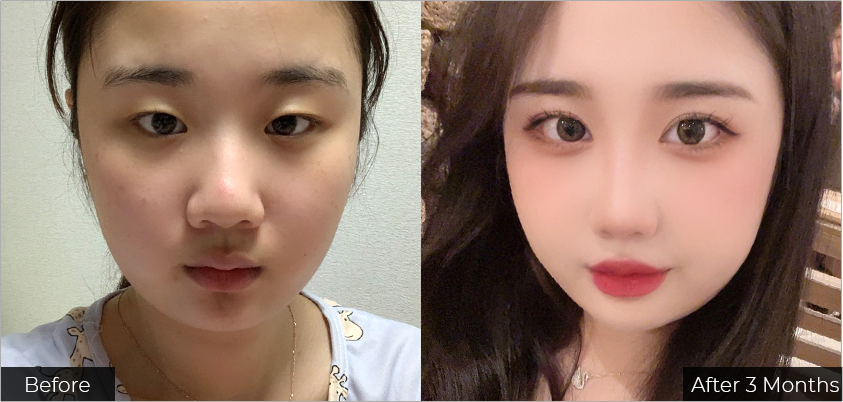
Asian eyes aren't actually smaller than normal. They're just designed different.
SOURCE
This isn’t some malfunction. It’s a unique design feature. But the whole thing has turned negative. So much so that it’s not just women feeling the pressure anymore. It’s everybody, men included.
The video that finally caught my attention on this topic starts off with the tragic story of Kwon Dae-hee, a 24-year-old university student who went into a Gangnam plastic surgery clinic for a V-line jaw procedure and never came out. He wanted the sharp, sculpted look seen on so many K-pop stars, Korean dramas, and reality stars. His family was worried, but he went anyway.
What followed was this horrifying operation that dragged on too long, involved an unlicensed doctor allegedly taking over part of the procedure, nurses left to monitor him as he bled, and a young man dying weeks later after chasing the kind of face his society demanded.
The high cost of glam.
SOURCE
DEBRIEFING
Obviously, South Korea didn’t invent beauty pressure. We’ve got plenty of it in the U.S., and so do Brazil, Turkey, and countries all over the world.
But South Korea is showing what happens when the pressure becomes organized, normalized, and baked into the culture at a massive scale.
Once employers, parents, schools, celebrities, and all the social media algorithms started pointing in the same direction, the person who says, “No thanks, I’ll keep my original face,” starts being the weirdo.
And that’s the dystopian part. And that’s also what got me thinking about North Korea, too. They control people with force. But these days, South Korea controls them with beauty standards. Obviously, they’re not the same thing, but for me, the contrast was still a bit chilling.
Basically, I boil it down to this: one side uses fear and state power, and the other shows what can happen when a free society becomes so competitive, image-driven, and status-obsessed that people begin policing themselves.
We live in a world where heavily filtered selfies have become surgery templates, and people are studying their own faces like flaws that must be fixed. Medical tourism is booming, and cosmetic procedures are easy to finance, are totally normalized, and are now explained away as “self-care,” or even survival.
But honestly, the line between self-improvement and self-erasure is getting really blurry.
NOW YOU KNOW
South Korea is showing the rest of us where the beauty machine goes when nobody hits the brakes.
Share your opinion
COMMENT POLICY: We have no tolerance for comments containing violence, racism, vulgarity, hard-core profanity, all caps, or discourteous behavior. Thank you for partnering with us to maintain a courteous and useful public environment!
Eyelids, nose bridges, breasts, a light skin tone, eye shape, and “looking more American” have been Korean obsessions since at least the late ’80s. Women who are in their 60s now led the way. So much so that Obiwan’s description of Darth Vader applies to them in paraphrase, “They are more plastic than woman.”
I always preferred one’s natural beauty, and Asian faces, so the sudden, overnight changes into a false appearance ruined a couple of “beautiful friendships” for me. My Chinese wife never fell for that crap – probably one reason we married.
Sad to see this. I can understand having plastic surgery to deal with birth defects or accidents that scar your face, but getting a “more beautiful” look does not change your personality and of course often doesn’t work (as shown on “Botched”), and you’ll get older (and likely less attractive physically) regardless.
The saddest part of the story is managers hiring for looks rather than merit and competence. Those actions create harm for people. `
Before you marry you’d better ask to see their high school photo.