[CYPHER CODE #1370]
Desire paths appear when human instinct stops obeying bad design.
[CYPHER CODE #1371]
The official route tells people where to go, the worn ground tells the truth.
[CYPHER CODE #1372]
People always find a way around what doesn’t make sense.
BRIEFING
Jett here. You walk past these buggers every day and probably never think twice about them. To you, they’re just a strip of dirt through the grass, a cut-through where people got tired of following the sidewalk, and a trail that wasn’t supposed to exist but somehow does. This very simple phenomenon is called a "pirate path" or, oftentimes, a “desire path.” Personally, I prefer the label "pirate path," arrrggghhh. Anyhoo, the path might look totally forgettable, maybe even boring, until you realize it’s one of the clearest and coolest physical records of human nature hiding in plain sight. Let’s get into it.
A pirate path is the unofficial trail people create when they stop following the route they were given and start taking the one that feels more natural. It shows up as a worn strip through grass or dirt, usually where the official path makes no sense.
SOURCE

Sometimes the route is clunky, annoying, or just plain stupid. Sometimes people can feel bad design before they can explain it. Either way, the ground starts keeping score, and a distinct pattern emerges.
SOURCE

These paths are what happens when human instinct overrules instruction. They show where people naturally want to go and where the official design failed to match real life. The map says one thing, but the feet say something totally different.
This has become such a big deal that planners and developers started paying attention. And in some cases, instead of fighting these unofficial trails, they actually study them, pave them, and make the desire a reality. So, in the end, the "mistake" becomes the truth. The path people weren't supposed to take becomes the one that made the most sense all along.
But this isn’t just about sidewalks or college campuses. It’s about what people do when rules, structures, and systems don’t line up with reality. Pirate paths are feedback carved into the earth.
SOURCE
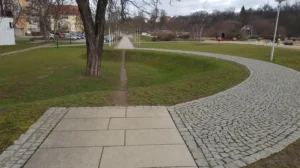
They are proof that human behavior always leaves a mark, and sooner or later even the people in charge have to notice.
Humans and even animals keep creating these worn little detours because sometimes the planned route doesn't jive with the soul...
SOURCE
So goes the logic of “desire paths” – described by Robert Macfarlane as “paths & tracks made over time by the wishes & feet of walkers, especially those paths that run contrary to design or planning”; he calls them “free-will ways”. The New Yorker offers other names: “cow paths, pirate paths, social trails, kemonomichi (beast trails), chemins de l’âne (donkey paths), and Olifantenpad (elephant trails)”. JM Barrie described them as “Paths that have Made Themselves”. Reddit has desire path threads, tens of thousands of people strong, delighting in the more mysterious or illogical-seeming of them. They can form anywhere from apparently forgotten corners of cities to the grounds of national governments, as has happened around the National Congress of Brazil; some are so well established that they are visible on Google Maps. Desire paths have been described as illustrating “the tension between the native and the built environment and our relationship to them”. Because they often form in areas where there are no pavements, they can be seen to “indicate [the] yearning” of those wishing to walk, a way for “city dwellers to ‘write back’ to city planners, giving feedback with their feet”.But as well as revealing the path of least resistance, they can also reveal where people refuse to tread. If you’ve been walking the same route for years, an itchy-footed urge to go off-piste, even just a few metres, is probably something you’ll identify with. It’s this idea that led one academic journal to describe them as a record of “civil disobedience”. Rather than dismiss or even chastise the naughty pedestrian by placing fences or railings to block off “illicit” wanderings, some planners work to incorporate them into urban environments. This chimes with the thinking of Jane Jacobs, an advocate of configuring cities around desire lines, who said: “There is no logic that can be superimposed on the city; people make it, and it is to them … that we must fit our plans.”
Once you see the pirate path, it's one of those things you notice everywhere. What makes this so interesting is not just that these paths exist, but that they keep appearing in the same stubborn ways, as if living beings are quietly correcting bad design without ever holding a meeting about it.
SOURCE
@dspacestv Desire Paths 🚶♀️
DEBRIEFING
That’s what makes these desire/pirate paths so interesting. They're not just random little shortcuts. They're proof that people will keep pushing toward what feels natural, efficient, and true, even when the rules tell them not to.
And once enough human feet make the case, the people who designed the original path sometimes have to give in and pave the one that formed on its own. Human behavior leaves a mark, and sooner or later, reality forces design to catch up, and that's pretty cool.
NOW YOU KNOW
The dirt always knows.
Share your opinion
COMMENT POLICY: We have no tolerance for comments containing violence, racism, vulgarity, hard-core profanity, all caps, or discourteous behavior. Thank you for partnering with us to maintain a courteous and useful public environment!
THIS article is a little gem of real journalism, one that makes us think.