[ CYPHER CODE #606 ]
You can walk across the Buriganga River without touching water because the garbage is doing the floating now.
[ CYPHER CODE #607 ]
Fast fashion doesn’t disappear when it leaves the store. It relocates to places consumers are trained not to look.
[ CYPHER CODE #608 ]
Environmentalism that never names the supply chain is performance, not principle.
[ CYPHER CODE #609 ]
The climate class obsesses over symbolic sacrifice while outsourcing real destruction to the global poor.
BRIEFING
Sloane here. The Buriganga River in Bangladesh is widely considered the most polluted in the world. So much so that you can literally walk on the water, held up by layers of debris. Time to dive in.
This Bangladeshi river runs alongside Dhaka, a city of more than 20 million people and one of the planet’s largest garment manufacturing hubs. Decades of untreated industrial waste from textile mills, dye houses, washing plants, and tanneries have turned the river into something closer to a dumping ground than a waterway. Oxygen levels have collapsed, aquatic life is gone, the water has turned permanently black, and the smell never leaves.
This event didn’t unfold by accident but rather in parallel with Bangladesh’s rise as a global fast fashion engine. As production scaled, environmental controls failed to keep pace and were, in many cases, deliberately bypassed. You see, treating wastewater slows production, raises costs, and complicates contracts in an industry built on speed and volume. It was far more convenient to dump directly into the river because it was faster, cheaper, and almost never punished.
The river becomes part of the system, not as a casualty, but as infrastructure. It’s the predictable result of a supply chain engineered to prioritize low prices and rapid turnover above everything else. Brands demand faster cycles and thinner margins, factories cut the only corners available, and distance does the rest, keeping consequences abstract and comfortably out of sight.
A viral clip shows the Buriganga River in Bangladesh so choked with trash and industrial waste that the surface is nearly solid, allowing people to walk on it, revealing the shocking scale of pollution in this once-vital waterway.
SOURCE
This river in Bangladesh is so polluted that you can walk on it.pic.twitter.com/Q92fsZoNeQ
— Massimo (@Rainmaker1973) December 17, 2025
This image illustrates how environmental collapse and daily life coexist when environmental damage is normalized as necessary. Pedestrians cross a bridge over a section of the Buriganga River so clogged with plastic waste and debris that the water beneath is barely visible. Life moves on above it, even as the river below functions as a landfill.
SOURCE

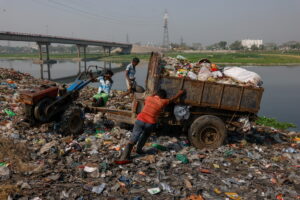
In this image, men load trash from the riverbank into a cart, standing amid layers of plastic waste and debris. The water beside them is dark and stagnant, the residue of years of untreated industrial discharge and urban runoff. The Buriganga no longer behaves like a river. It functions as a waste-management extension for the city and its surrounding industries.
SOURCE
DEBRIEF
The Buriganga River isn’t an outlier. It’s a case study in how global systems distribute damage. When cost, speed, and distance align, destruction doesn’t vanish. From the outside, this appears to be an environmental collapse. Within the system, it appears efficient, with production continuing, contracts intact, and consumers insulated from consequences.
By the metrics that matter to the supply chain, nothing is broken. Rivers like the Buriganga will keep absorbing what the market refuses to account for. Not because no one knows. Because knowing has never been the obstacle.
NOW YOU KNOW
The system is working exactly as designed, and the river is paying the price.
Share your opinion
COMMENT POLICY: We have no tolerance for comments containing violence, racism, vulgarity, hard-core profanity, all caps, or discourteous behavior. Thank you for partnering with us to maintain a courteous and useful public environment!
Yes, Indians. The ones whom throw cow poop at each other, and eat it too.
Question; When do the actual deportations start?
Stop all workers visas immediately please, forever.