[ CYPHER CODE #610 ]
What hearing audiences read as “overacting” is the language doing its job.
[ CYPHER CODE #611 ]
ASL makes wild faces because sound doesn’t exist.
[ CYPHER CODE #612 ]
ASL looks exaggerated only because most people were never taught how it works.
BRIEFING
Sloane here. If you’ve ever watched an ASL interpreter during a live broadcast and thought the facial expressions looked intense, dramatic, or even “over the top,” you’re not alone. Hearing audiences instinctively read facial expressions as "emotional," and some of these interrupters look downright crazy. Time to dive in.
This clip went viral because viewers thought the interpreter was “overdoing it.” Some even accused her of faking it. But she wasn’t. This technique is standard practice in the ASL community. What you’re watching is actually ASL working at full precision, with facial grammar carrying meanings that spoken language usually hides in sound.
In other words, the "face" is replacing the "sound."
SOURCE
Providence Police appears to be using a fake signer for their press conferences. Everything about this is a joke. pic.twitter.com/qAmiutTGeF
— Ian Miles Cheong (@ianmiles) December 17, 2025
In American Sign Language, facial expressions aren’t optional the way tone of voice is in English. They are part of the grammar itself, carrying information like questions, emphasis, negation, and intent.
That’s where the disconnect happens. Hearing people use facial expressions too, but when the intensity goes beyond what we’re used to, our brains read it as acting or theatrics.
In ASL, though, that “theatrical” look is doing real work. Eyebrows, mouth shape, head movement, and posture carry meaning the same way tone and inflection do when we speak. Strip those away, and the message doesn’t just soften, it breaks.
SOURCE
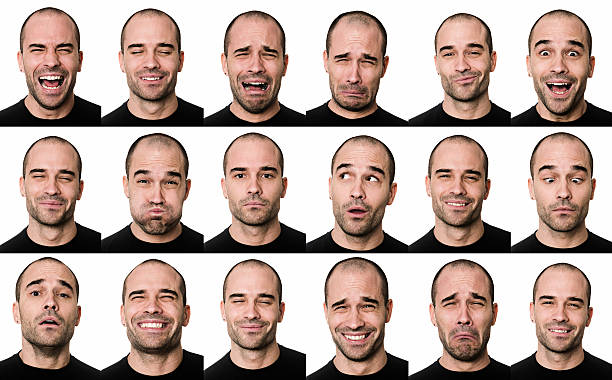
This clip helps explain why ASL interpreters rely so heavily on facial expression and body movement. In ASL, more than half of the meaning can live in the face and the body, not just the hands. That’s why new signers struggle at first, and why what looks exaggerated to outsiders is actually necessary for clear communication.
SOURCE
What this shows is just how detailed ASL communication can be. Tiny adjustments in expression or movement can turn one idea into several entirely different ones, in the same way spoken language shifts meaning with emphasis or phrasing.
SOURCE
Why must a myriad of countless facial expressions accompany the delivery of many signs? Because each facial expression serves a vital and specific linguistic purpose. Facial expressions, often done in conjunction with other factors, are used as follows:
a) to indicate which of two meanings a sign conveys (i.e. the sign for 'rolling on the floor laughing' and 'seizure' are similar; they are distinguished, one from the other, primarily by facial expression. The signs for 'evil' and 'mischievous' are similar, facial expression distinguishes one from the other. The signs for 'regurgitate' and 'that's disgusting!' are similar, facial expression and other factors distinguish one from the other.
b) to soften or intensify the meaning of a given sign (i.e. to change the meaning of a sign from 'a little angry' to 'really angry' to 'furious,' 'livid' or 'in a rage.' Or, to change the meaning of the sign for 'stop' to mean 'pause' (by signing a much smaller, less forceful, softer version of the sign for 'stop')
c) to change the meaning of a sign to a totally different meaning (i.e. to change the meaning of the sign for 'Whoa!' as in: 'Whoa! Your brand-new BMW is beautiful!' to 'Whoa! There's a rattlesnake by your foot!')
d) to change the meaning of a sign to an opposite meaning by accompanying the sign with a 'no' head-shake (i.e. to change the meaning from 'I'm hungry' to 'I'm not hungry.' Or, from 'I'm happy' to 'I'm not happy.' Or, from 'employed,' to 'unemployed.'
e) to indicate which of several meanings is intended by a sign that can convey multiple meanings (i.e. the sign for 'odor' can also mean 'fragrance,' 'aroma,' 'fumes,' 'scent' and 'smell.' And, depending on facial expression, it can mean, 'I smell something,' 'Something smells good!' 'Nice fragrance!' 'Something smells bad.' Or, Eww! 'Something smells terrible!' And, if we sign 'smell' and shake our head 'no' it can mean, 'I don't smell anything.' Or, 'I don't detect any fumes.' If we furrow our brow and sign 'smell' it can mean 'What's that smell?'
f) to alter the meaning of a sign in terms of emotional tone (i.e. to change the meaning of a sign from, 'Please stop that,' said in a calm, pleasant tone to 'Stop that right now!' or 'Cut that out!' said in an exasperated or angry tone. Or, to change the meaning of a sign from "I don't mind' (said in a calm, pleasant tone) to 'I don't care!' (said in an angry or defiant tone); the signs for those two concepts are similar, facial expression and other factors distinguish one from the other.
The manner in which we make and deliver a sign can also alter the meaning of the sign. The meaning can be altered by:
a) how small or large we make a sign (i.e. a very small version of the sign for 'mistake' accompanied by an "uh-oh!' look on the face can mean 'Oops!' or 'a blooper.' If we exaggerate the sign for 'mistake; and alter our facial expression to include a 'Cha' mouth morpheme, it can mean 'BIG mistake!' Exaggerate the sign and facial expression even more and it can mean, 'BIG, SERIOUS mistake!' If we make an exaggerated version of the sign for 'big' it means 'huge.' Make it even larger and it can mean 'humongous,' 'enormous,' or 'gargantuan.' If we make a small, quick version of the sign for 'pain' it means 'Ouch!' or 'That hurt! If we make a very-small, softer version of the sign for 'depressed' it can mean: disillusioned; dispirited; down in the dumps, feeling blue, it was a let-down, etc. If we make a very small and softer, slower version of the sign for 'thrilled' it can mean 'a pick-me-up,' 'a boost to one's ego or self-esteem,' 'a little wind beneath one's wings,' or it can mean 'uplifting' or 'lifted one's spirits' or 'made me feel better.'
b) the speed with which we deliver a sign (i.e. we can adjust the speed, rhythm and style of the sign for 'walk' to mean any of the following: a typical speed and way of walking, a sluggish walk, a brisk walk, a walk that approaches a run, a labored walk, to walk with a bounce in one's steps, a stealthy walk, to walk with a limp, to walk with a swagger, to be very attentive and vigilant about one's surroundings while walking, to stomp around, a drunken walk, to walk in a 'marching' manner, to tiptoe, to take a few steps back, etc.
c) whether we make a sign one time or two times; with noun-verb pairs, verbs are often made with one motion and nouns are made with two, relatively small motions. For example, the verb, 'to fly' (in an airplane) is done with one motion; that same sign, done with two small motions, means 'airplane' (noun). The verb 'grow' is done with one motion; that same sign done with two small motions means 'plant,' 'garden,' or 'spring' (the season). The verb 'to sit' is done with one motion and the noun 'chair' is done with two small motions. Not all nouns and verbs have pairs, so there are many exceptions to this one-motion, two-motion guideline.
d) whether we make a sign just one time or repeat it several times (i.e. the sign for 'again,' when repeated several times, can mean often, frequent, frequently, recurs, recurring, repetitive or repetitious. The sign for 'drive to,' repeated several times can mean 'drove and drove and drove! ' The sign for 'forget,' when repeated several times can mean 'forgetful,' or 'I keep forgetting.' The sign for 'go-to,' when repeated several times can mean 'to frequent a place,' or 'go/goes there often,' or 'attend or attends,' as in: He attends the Episcopalian Church. If we repeat the sign for 'talk' several times it means, 'talkative,' or 'talked, and talked and talked.'
e) whether or not we 'tighten' our fingers/hands when we deliver a sign (i.e. if we 'tighten' our fingers when we sign 'connection' it can mean 'a tight connection.' If we tighten our fingers when we sign 'friend' it can mean 'a best friend' or 'a very close friend.' If we tighten our fists and exaggerate the sign for 'Grrr...I was so annoyed!' and show an angry facial expression it means 'Grrr . . . it made me so angry!' If we tighten our fists and sign 'strong' in an exaggerated manner it means 'super-strong,' or 'great strength!'
f) the direction in which we move a sign (i.e. the sign for 'to put one's foot in one's mouth,' when moved toward our own mouth means 'I put my foot in my mouth.' If moved toward another person it means 'that person put his or her foot in their mouth.' If the sign for 'help' moves toward another person it can mean 'I can help you' or 'I will help you.' If it moves toward another person and is accompanied by raised eyebrows it means, 'Do you want my help?' or 'Do you want some help?' or 'Can I help you?' If it moves toward yourself while making eye contact with someone and is accompanied by raised eyebrows it means, 'Can you help me?' or 'Would you help me?' If we make that same sign ('Can you help me?') with harsh, glaring eye contact and with an angry facial tone it could mean, 'Can't you see I need help! Or an exasperated, 'Geez! The least you could do is get up and help me!' Or, 'How about some help over here!?' There are countless examples of how movement changes or determines the meaning of a sign.
g) the distance to which we move a sign - a short distance or an extended distance (i.e. we can sign 'future' to convey a general meaning of future, or we can move our hand out farther in front of us, to mean 'in the far-distant future.' If we make the sign for 'close by,' 'nearby,' 'in close proximity,' and move it in one, very quick and very-short distance from the tip of our nose, it means 'in extremely close proximity,' or 'extremely close.'
h) whether or not we raise our eyebrows when we make certain signs; raised eyebrows indicate that we are asking a yes-no question and are hoping for or expecting a yes or no answer (i.e. if we raise the eyebrows and sign 'Drink?' it means 'Do you want something to drink?' If we raise our eyebrows and sign 'Finished?' it means, Are you finished? If we raise our eyebrows and sign 'Ready?' it means 'Are you ready?') If we raise our eyebrows and sign 'like-it?' it means, 'Do you like it?' If we raise our eyebrows and sign 'enjoy?' it means 'Are you having a good time?' or 'Are you enjoying yourself?'
i) whether or not we furrow our brow when we make certain signs; a furrowed brow can indicate, among other things, that we are asking a who, what, when, where, why or how type of question and that we hope for, or expect, that type of information in a response to our question (i.e. if we furrow our brow and sign 'live' and then sign 'you,' and then sign 'where?' it means, 'Where do you live?' If we make eye contact, furrow our brow and sign, 'Your, brother, where?' it would mean, 'Where is your brother?'
j) delivering what is usually done as a one-handed sign, with both hands, simultaneously and emphatically (i.e. if we sign 'don't know' emphatically with both hands it can mean 'How would I know!?' or "I don't know!' or 'I don't have a clue!' If we sign 'not' emphatically with both hands it can mean 'Absolutely not!' If we sign 'away' emphatically with both hands and show a look of annoyance or disgust on our face it means, 'Be gone!' or 'Get out of here!' or 'Go away!')
DEBRIEFING
Those of us who hear just fine are used to judging sincerity and intent by how closely something matches our communication norms. When a facial expression crosses the line from casual emphasis into what we think is constant theatrics, our brains mislabel it as a performance.
But in ASL, that level of intensity isn’t exaggeration. It’s clarity. What looks theatrical through a spoken-language lens is simply a language operating by different rules, ones most people were never taught to recognize.
NOW YOU KNOW
Those “crazy faces” are grammar.
Share your opinion
COMMENT POLICY: We have no tolerance for comments containing violence, racism, vulgarity, hard-core profanity, all caps, or discourteous behavior. Thank you for partnering with us to maintain a courteous and useful public environment!