[ CYPHER CODE #397 ]
When fast food becomes a luxury, the economy is already broken.
[ CYPHER CODE #398 ]
McDonald’s didn’t raise prices because they had to. They raised them because you kept paying.
[ CYPHER CODE #399 ]
$4 fries aren’t inflation. They’re a corporate stress test on the American consumer.
BRIEFING
Grant here. Fast food used to be one of those things that was built for convenience. A lot of the times when you were too tired to cook and didn't want to spend a fortune at a restaurant, grabbing a quick burger and fries was a perfect middle ground. But now, going out for fast food, while still relatively convenient, now costs just as much as a restaurant and is exponentially more expensive than cooking at home. The truth is, the prices aren't simply rising due to inflation; these chains are literally pulling "highway robbery" because they've been allowed to. Let’s break it down.
Starting with the headline numbers: between 2019 and 2024, McDonald’s hiked prices by triple digits on items that used to be America’s cheapest, most stable goods. A cheeseburger jumping from one dollar to more than three isn’t a sign of inflation, but it's a shift in the entire cost structure of everyday life. And the video clip that kicked off this conversation makes the real point: these hikes aren’t about necessity. They’re about how far corporations realized they could push consumers before people finally snapped.
SOURCE
McDonald’s Price Increases from 2019 to 2024:
Medium French Fry $1.79 -> $4.19
McChicken $1.29 -> $3.89
Big Mac $3.99 -> $7.49
10 McNuggets $4.49 -> $7.58
Cheeseburger $1.00 -> $3.15Some of this is over a 200% increase in price. This isn’t inflation — it’s legalized robbery. pic.twitter.com/jCwVRcO9gu
— MatrixMysteries (@MatrixMysteries) November 19, 2025
But listen closely to the economist in the segment as he says the quiet part out loud: the bigger threat isn’t even the prices. It’s the weakening labor market underneath them. In other words, Americans aren’t just being hit with higher costs. They’re being hit with higher costs while their paychecks stagnate and job security erodes.
The result? A consumer base that’s stretched, resentful, and running out of margin, and yet corporations are still squeezing them for every last dollar.
And if you need more proof that McDonald's is squeezing every last penny out of hard-working Americans, despite supposed inflation, look no further than this chart here:
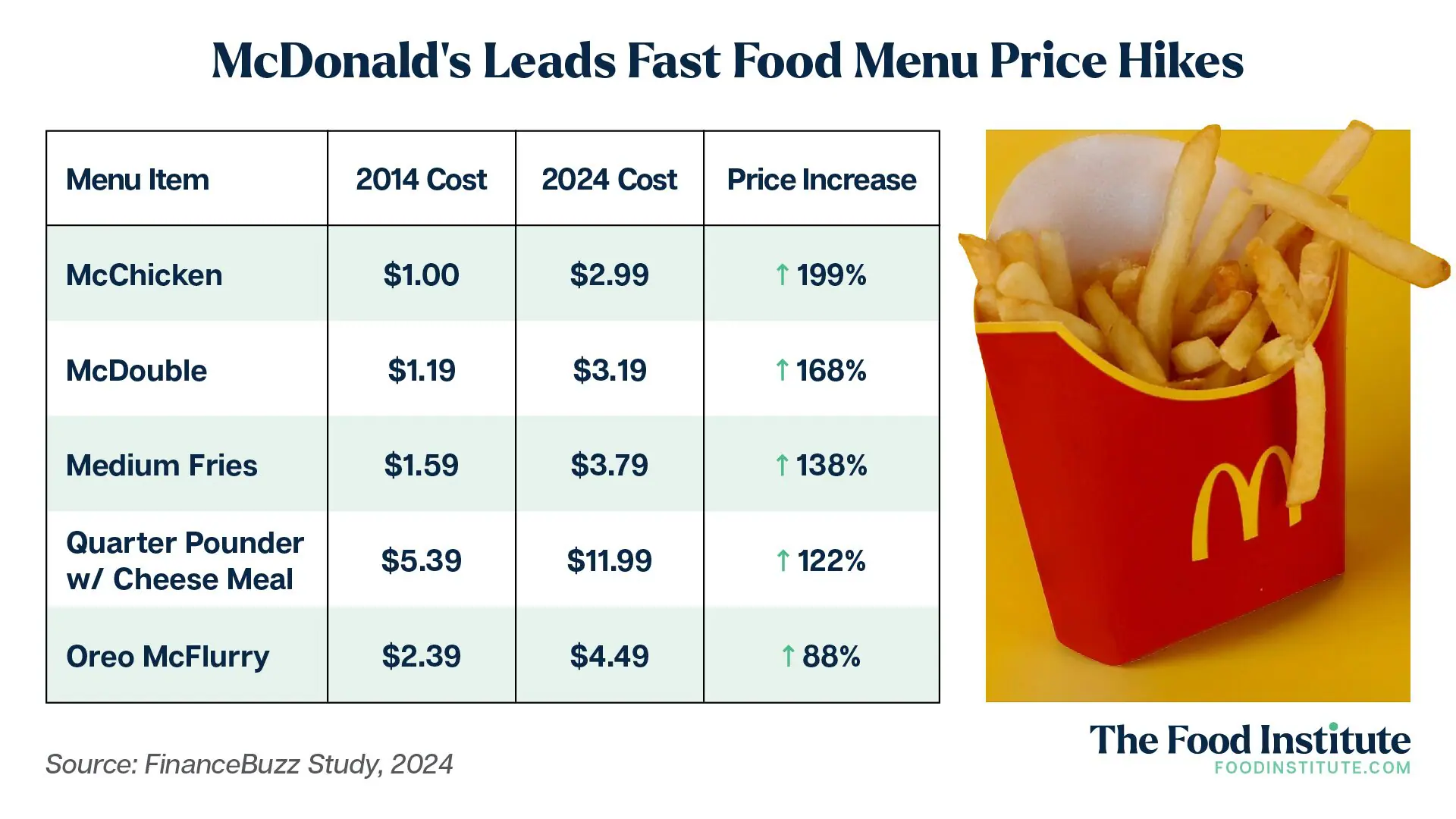
And it’s not just McDonald’s proving the point. When you zoom out across the fast-food sector, the pattern gets even harder to ignore. Some chains are running the same high-velocity price hikes, pushing increases far beyond anything inflation can justify. Others are holding prices steady, showing that these jumps aren’t inevitable, but they’re strategic and selective. They’re basically market testing disguised as economics.
SOURCE
Meanwhile, Popeyes, Taco Bell, and Chipotle exhibited the second, third, and fourth-largest average price increases, respectively. All three have raised prices by at least 75%.
Other leading price hike percentages by menu item include:
- Popeyes Regular Mashed Potatoes & Gravy (+134%)
- Taco Bell’s Beefy 5-Layer Burrito (+132%)
- Wendy’s Small Frosty (+111%)
- Taco Bell Chalupa Supreme (+110%)
- Burger King Small Icee (+101%)
- Taco Bell Cheesy Gordita Chunch (+100%)
Noteworthy Pockets of Moderation
Chains like Subway have kept price increases in line with inflation over the past ten years. Burger King also received honorable mention, with the average cost for menu items rising by “just” 55% in that same time.
In terms of keeping costs down, Starbucks was one of the best chains evaluated. The coffee house’s menu prices went up by 39% on average, which is only slightly higher than the actual inflation rate during that time.
Certain items like the Caffè Latte (+22%) and Caramel Macchiato (+17%) have actually risen slower than inflation, making them a better deal now than they were a decade ago.
DEBRIEFING
The truth behind $4 fries is not inflation, but instead it's the moment the American consumer hit the ceiling of what corporations believed they could get away with. McDonald’s wasn’t raising prices because its costs were exploding; they hiked up prices because the last five years taught every major chain that customers would tolerate almost anything as long as the increases came with the right excuses. When a cheeseburger can triple in price and no one blinks, you don’t have a healthy economy. You have a captive market.
And the pattern stretches far beyond one menu board. Popeyes, Taco Bell, Chipotle, and Wendy’s ran the same experiment and pushed their prices into the stratosphere. But not because they had to, but because they discovered consumers would keep buying out of habit. Meanwhile, chains like Subway, Burger King, and even Starbucks kept increases close to inflation. That difference matters, and it proves this is not a universal cost crisis, but it's a strategic decision, and some companies are using inflation as a cover while others are not.
The economist in the original clip said the quiet part out loud: the price hikes are running headfirst into a labor market that's starting to crack. Wages aren't keeping up, and job security is weakening. People are stretched thin, and sentiment data shows it.
And that's the key point in all of this: fast food isn't supposed to be a luxury. It's supposed to be the bottom rung of the price ladder. When the lowest rung gets ripped out, the entire structure becomes unstable.
NOW YOU KNOW
The fries weren’t the problem. The system was.
Share your opinion
COMMENT POLICY: We have no tolerance for comments containing violence, racism, vulgarity, hard-core profanity, all caps, or discourteous behavior. Thank you for partnering with us to maintain a courteous and useful public environment!
Ain’t seen a possum in months and all of a sudden The McRib is back?
Yet people keep buying the garbage.
Capitalism at its finest and The newest American way!
Its not just fastfood hosing the American consumer.
“…what corporations believed they could get away with…” – right.
Some people might still be willing to accept it, but I stopped buying fast food, pretty much ALL OF IT, years ago.
Quality’s raunchy – they push the cheapest grizzly meat they think find, service is in the toilet, people who cook it don’t give a rat’s ass what they turn out, and Big Macs have devolved into tiny sandwiches the size of sliders.
And they expect customers to just keep coming back for more? Not happenin’ here – they can keep their over-priced cheap-ass low-quality garbage, far as I’m concerned. I want NONE of it.
I am going to go get me a giant size hamburger and fries tomorrow, I think I’ll make it three. Thanks for the idea.
That will be $64.95… Would you like fries with that?
If that’s the only choice you have in Minnesota, go for it.
1Lb ground 7$ – $9. I pound fries ~$3. 12 oz soda $0.5 – $1.5
Depending on the region and the brand you choose, that’s about $14 for 2 husky people or 3 average size people or 4 pre-teens.
The fast food for 2 about $20, for 3 almost $30. 4 Kids getting kids size, close to $40. The variations of locations and brands is important.
Get a double cheeseburger. Buy one get a second for a buck. Then med fries, buy one get a second for a buck. All for under $10.
I think these prices should be increased by twice what it is now. Perhaps people will rethink the crap they eat and the cost of it, not to mention the toll it takes on one’s health. Eat America foods and get American sicknesses. It’s that simple.
My daughter likes Wendy’s. I will get her Wendy’s once every two weeks but I don’t buy anything because I can make a healthier better tasting burger or chicken sandwich. I used to buy fast food because it was cheap and quick. Now it is expensive and grossly unhealthy. Good riddance to them
is someone forcing people to buy mcdo’s?
All occurred during the Scam a Demic.
3/15 was allowed and stolen elections were ok
Over priced crap, Myocarditis and HIV was all ya got
Bummer
This is another manifistation of the relationship between large, financially success corporations and the men who control them and the American citizenship. The citizens are not seen as compatriots of the nation named United States of America. They are seen as a crop to be harvested. The number of crop facets are limited only by the creativity and greed of the harvesters. Here is a facet personally experienced. Home insurance renewal. Same house, same neighborhood crime rate, same owner, same provider year after year. Same on time annual premium payment. Modest increases or none at all until 2024. Bam, notice of cancellation unless drastic modifications to the house and yard were done in the next 90 days. 50% increase in rates once conditions met. In other words,$4.00 medium fries.
I notice lots of he fast food outlets are nearly empty.
Very overpriced, low quality food prepared by Blacks and foreigners that hate you. I’ll pass.
I was in the military in Hawaii for some of the 1960s.
I could buy a Big Mac Meal for under $1.
I remember when the big mac was 15 cents. The sign said millions sold…
Let’s see…
Decreased production and severely reduced reserves causes unnatural shortages, causing a spike in fuel and transportation costs.
The above does not excuse any corporate abuse above and beyond the listed examples (of the many that could cause this inflation).
The above is the fault of a single political party to cause the above examples. It is also the fault of the other political party to not do anything to stop the governmental or corporate fraud.
And not to mention the atrocious health quality of.
Done with madonna sorry
I refuse to eat their CRAP!!!!!!!! So it doesn’t cost me anything!!!!!!!!!
And Americans and a lot of others buy skims and over priced named khardashian cosmetics from a 20 y/o and linre up in front of the TV week after week based on the mommy releasing her daughters sex tape so that a vapid, talentless, worthless, morally bankrupt, trash family are multi millionaires to billionaires. That they accept a $7 burger probably made out of pink slime is not surprising.
Here the fast food places have to start workers at $22/hour or else they won’t have any. That’s over $40/hour when you factor in taxes, insurance, benefits, etc. They are open 24 hours a day and staff between 8-20 employees at a time depending on how busy it is and how many people show up. So $5,000.00/day labor cost is reasonable. The lease payment for the store footprint is $20k/month. So that’s $170,000/month just for rent and labor. I can’t imagine the utilities (electricity is 34 cents/kwh) plus the cost of the food, but at $7 per big mac they would have to sell 25,000 of them just to break even on rent and labor and that doesn’t include what they have to pay for the ingredients to make the big macs. Also these figures don’t include maintenance, franchise fees, paying taxes and regulatory compliance / professional fees, remodeling every 2-5 years, etc. I think the figures in this article grossly underestimate labor costs, which is the largest cost a franchise have. We’ve seen a lot of fast food places, and restaurants in general board up and close with labor cost and lease payments being cited as the reasons. Fast food isn’t able to push a lot of the labor cost onto the consumer like tipping restaurants can.